Music Segmentation
Detect structural changes in music using fastcpd.
Overview
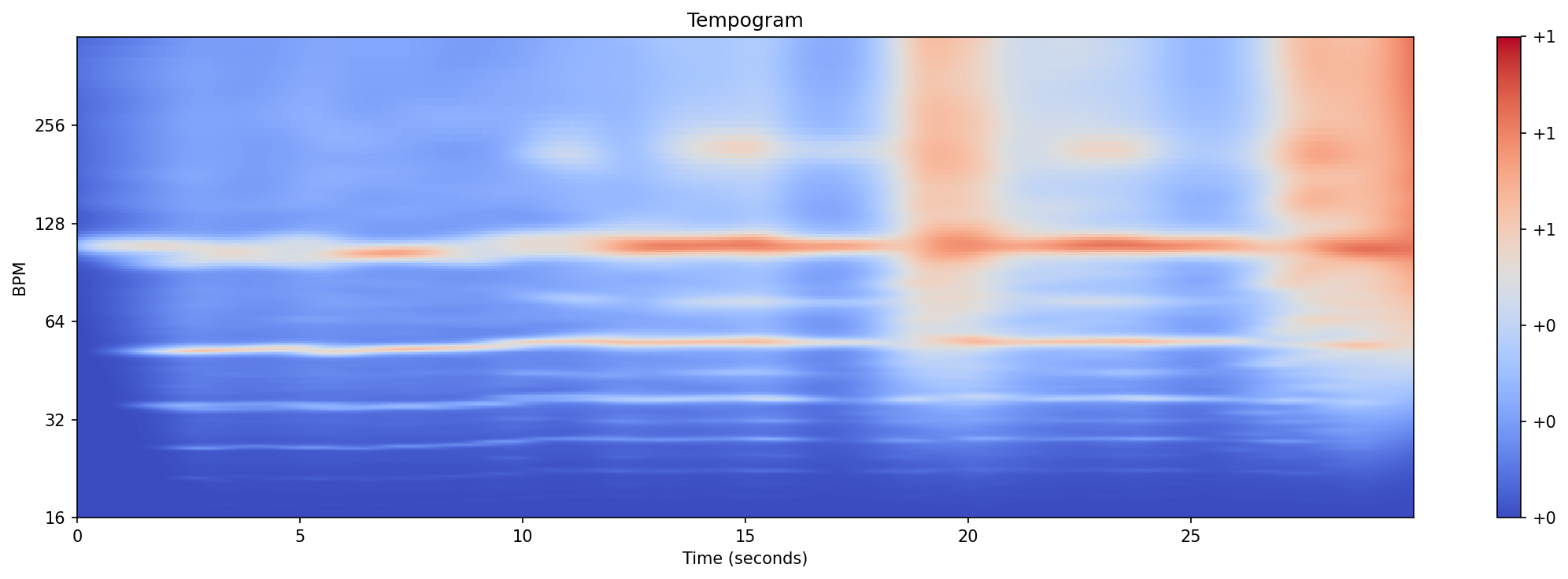
Music segmentation identifies temporal boundaries between sections in a song (intro, verse, chorus, etc.). We use fastcpd’s RBF kernel to detect changes in the tempogram - a representation capturing tempo patterns over time.
Audio Example:
Dance of the Sugar Plum Fairy by Tchaikovsky (30 seconds)
Setup
pip install librosa matplotlib pyfastcpd
import librosa
from fastcpd.segmentation import rbf
Load and Process Audio
# Load 30 seconds of audio
signal, sr = librosa.load(librosa.ex("nutcracker"), duration=30)

# Compute tempogram (tempo representation)
hop_length = 256
oenv = librosa.onset.onset_strength(y=signal, sr=sr, hop_length=hop_length)
tempogram = librosa.feature.tempogram(onset_envelope=oenv, sr=sr, hop_length=hop_length)
Detect Change Points
# Detect changes using RBF kernel (nonparametric method)
result = rbf(tempogram.T, beta=1.0)

# Convert to timestamps
times = librosa.frames_to_time(result.cp_set, sr=sr, hop_length=hop_length)
print(f"Detected {len(result.cp_set)} change points at: {times}")
Results
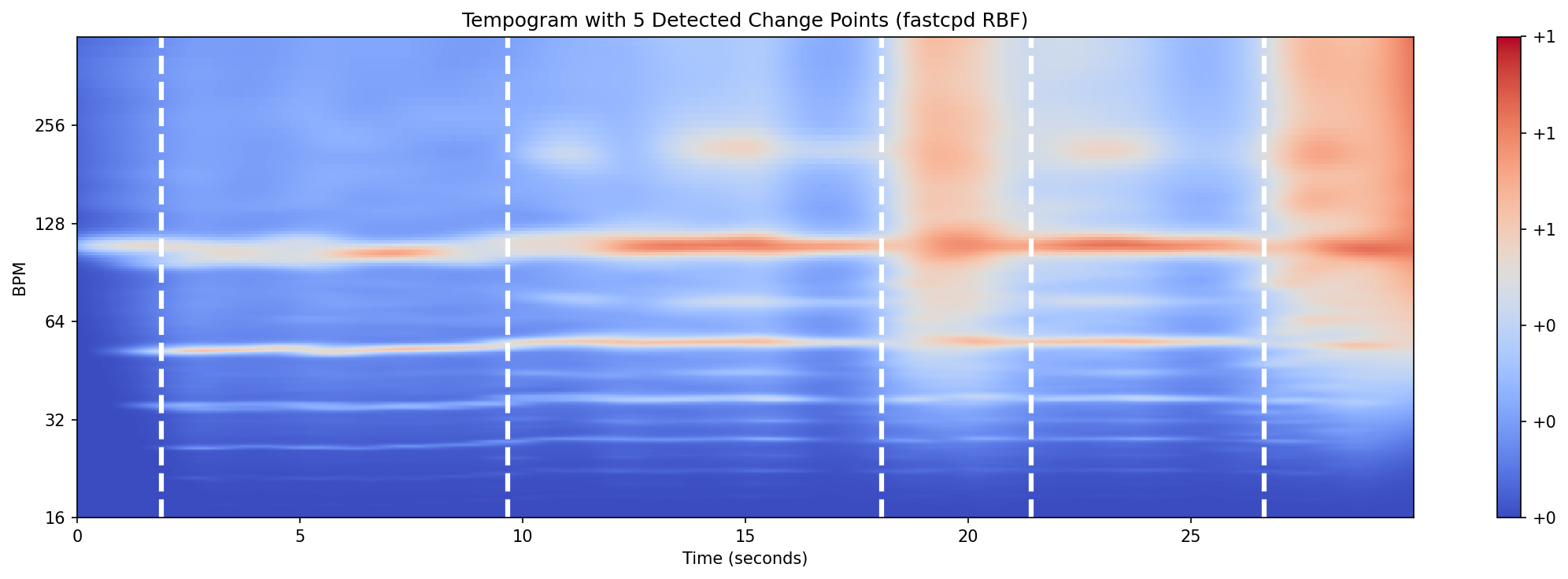
The algorithm detected 5 change points (white dashed lines) corresponding to major tempo transitions in the music.
Cost Function
For a segment from time \(s\) to time \(t\), the RBF kernel cost is:
where \(k(x, y) = \exp(-\gamma \|x - y\|^2)\) is the RBF kernel.
This measures the variance of data points in the embedded kernel space, with lower cost indicating more homogeneous segments.
Tuning Parameters
Adjust beta to control segmentation granularity:
rbf(data, beta=10)  # Conservative (fewer change points)
rbf(data, beta=1)   # Balanced (recommended)
rbf(data, beta=0.5) # Sensitive (more change points)
Complete Example
See examples/music_segmentation_example.py for a full runnable script with visualization.